
How to Use AI For Digital Signage Audience Measurement
Key Takeaways
- AI audience measurement for digital signage combines footfall, dwell time, and anonymous segments with proof of play.
- Digital signage software needs verified playback before it can be used. Without proof of play, measurement, and reporting become disputable at scale.
- Enterprise-ready software must support permissions, monitoring, and exports at scale so performance reviews stay consistent across regions and screen types.
- An AI retail analytics platform helps teams compare exposure signals across stores and zones.
- AI retail customer analytics stays anonymous and supports operational decisions tied back to verified playback.
AI measures footfall, dwell time, and broad demographic segments around a screen. Proof of play confirms what ran and when. Together, they show which locations perform best. A cloud-based software reports consistently and is privacy-safe at scale.
What is AI Audience Measurement in Software for Digital Signage?
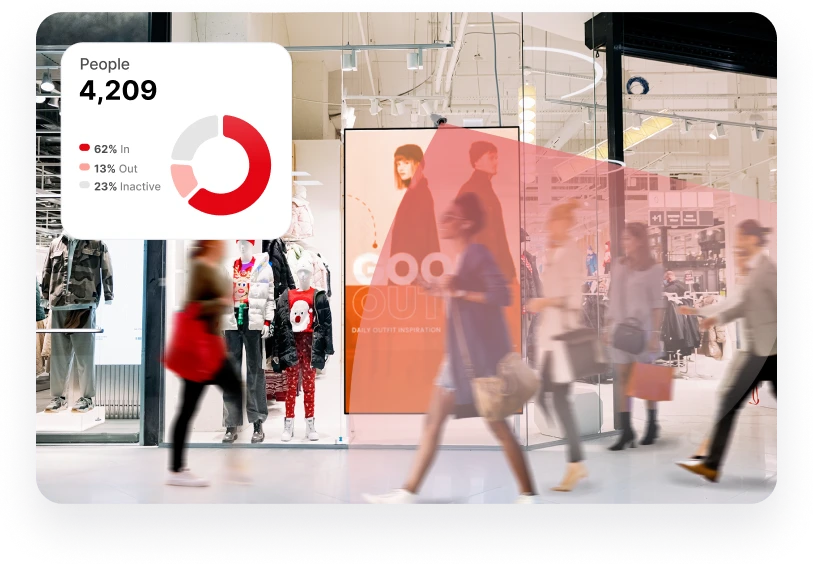
AI audience measurement is a camera or visual sensor that observes movement near the display and estimates metrics like footfall and dwell time. In enterprise deployments, the objective is to standardize what counts as the measurable zone, how sensors are installed, and how data is rolled up across locations.

Importance of Audience Measurement in AI Retail Analytics
AI in digital signage software helps teams compare footfall and dwell time across stores, zones, and time windows.
Most enterprise teams can already verify what played, where, and when through the platform. However, they cannot measure audience engagement. AI in digital signage closes that gap by combining computer vision signals with playback logs, enabling clearer performance reviews as networks scale with digital signage TV software and digital signage media player software.
How An AI Retail Analytics Platform Fits Into Digital Signage Measurement
An AI software helps teams compare footfall and dwell time across stores, zones, and time windows. AI retail customer analytics is most valuable when it remains anonymous and supports operational decisions, such as identifying underperforming locations, low-traffic periods, and promotions that work, with results tied back to verified playback reports.
What AI Can Measure Around the Screens
AI audience measurement does not replicate web analytics. It captures signals that reflect how people move in physical spaces.
| Measurement | What It Indicates | How Teams Use It |
| Footfall | How many people passed through the screen zone? | Compare locations, validate placement, plan expansion |
| Opportunity To See Proxy | How many people plausibly had exposure? | Support reach assumptions and placement comparisons |
| Dwell Time | How long did people stay in view? | Evaluate creative clarity and queue programming |
| Anonymous Demographic Segments | Broad audience mix by age range and gender | Tune rotations by time of the day and location |
| Weekday And Hour Patterns | Repeatable traffic peaks | Align offers and operational messaging to peaks |
| Proof Of Play Correlation | What ran during measurable audience presence? | Identify strong content and retire weak assets |
Software for digital signage provides anonymized demographic segments, typically age range and gender, reported in aggregate. For outdoor environments, vehicle detection is sometimes used to estimate traffic volume near roadside displays.
These measurements are captured in digital signage TV software on commercial displays and sites using dedicated players with digital signage media player software, provided the measurement zone is consistently defined, and reporting is standardized across the network.
How Cloud-Based Digital Signage Software Helps Scale Measurement
Audience data becomes useful only when it stays comparable across the estate. That is why multi-site teams often rely on digital signage cloud software to standardize rollout and reporting. Central teams can apply consistent governance, measurement settings, and reporting outputs without relying on store staff for setup and troubleshooting.
Navori Supports Audience Measurement In Multi-Site Networks
Navori supports AI audience measurement by turning audience signals into a credible report that you can compare across locations. It captures metrics such as footfall and conversion duration, then breaks down the results by weekday and hour to support scheduling and creative decisions. The focus is measurable exposure, measurable engagement time, and reporting that stays consistent across the network.
Cloud-Based Digital Signage Software
AI audience measurement for digital signage works when it stays evidence-led. Verify playback first, then track a small set of consistent metrics, plus weekday and hourly patterns for scheduling decisions. Use cloud-based digital signage software to standardize governance and reporting across locations. The result is defensible performance reporting and faster, scalable optimization.
What is digital signage AI audience measurement?
It uses sensors and analytics to measure audience activity around screens. It focuses on how many people were present, how long they viewed the screen, and how long they engaged with specific content.
Why does proof of play matter before audience analytics?
Proof of play matters because audience metrics are only credible when you can confirm what played, where it played, and for how long. Proof of play prevents reporting disputes and keeps measurement tied to actual delivery.
What is the difference between footfall and dwell time?
Footfall measures how many people pass near a screen or through a defined zone. Dwell time measures how long people remain in the zone. Footfall helps evaluate audience volume. Dwell helps evaluate attention potential.

