
Best Digital Signage Software for Retail Analytics in the UK
Key Takeaways
- The best digital signage software for UK retail keeps your screen network under control and easy to measure as it grows.
- Proof of play and playback verification are the starting point for reporting you can trust.
- Retail analytics should show what ran, who saw it, and what changed in the business, not just produce reports.
- Cloud-based digital signage software makes it easier to manage content remotely and maintain consistent branding across locations.
- Advanced analytics only matter if they help teams decide what to fix, adjust, or improve next.
In retail, signage is not a one-off content task. It’s an operating layer for promotions, wayfinding, service messaging, and partner campaigns across an estate. For large UK retailers, the best digital signage software is the one that keeps your screen network controlled and measurable at scale. It lets you publish remotely, verify what played, and report performance with evidence across every store. Without verified delivery, retail analytics becomes inconsistent and unreliable.
What is Digital Signage Software?
Digital signage software is the system that controls retail digital signage or a network of screens and includes a centralized content management system (CMS). The software lets you create, schedule, publish, and manage content remotely. The content is shown through digital signage TV software or digital signage media player software.
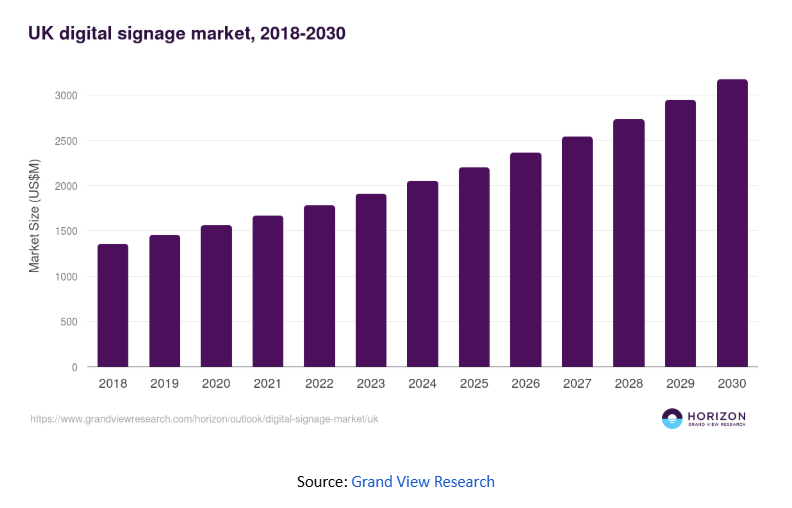
Grand View Research projects the UK digital signage market to reach about US$3.17B by 2030. As estates expand, weak governance leads to predictable issues, including incorrect content by location and reporting that stakeholders stop trusti
Benefits of Using Retail Analytics Software for Digital Signage in the UK
Faster Updates Without Store-Level Work
Head office can push promotions, pricing messages, seasonal campaigns, and compliance notices across the network from one CMS. Stores don’t need to print, swap posters, or troubleshoot content changes on the floor. Updates happen fast, and they happen consistently.
Consistent Branding, With Room for Local Variation
You can lock core brand rules (design, tone, legal lines) while still allowing location-level differences, such as regional offers, store events, or local partner content. The key is controlled publishing, so the right message goes to the right screens.
Better In-Store Experience for Shoppers
Retail signage isn’t only advertising. It improves engagement, wayfinding, product education, queue messaging, and real-time store information. Shoppers find what they need faster, understand offers more clearly, and feel wait times are shorter.
Retail and Hospitality Execution at Scale
Retail and hospitality networks operate at a faster pace than many other sectors. Promotions change frequently, pricing updates by region, and operational messaging changes throughout the day.
In retail and hospitality, the best cloud digital signage software for retail in 2026 has to support high-change environments without creating operational noise, especially across different store formats. In these environments, digital signage cloud software must handle:
- Region-specific pricing or menu updates
- Peak hours promotional changes
- Compliance messaging by country
- Mixed hardware environments across store formats
Retail Analytics That Improves Decisions
Analytics should answer questions like:
- What played?
- Where?
- For how long?
- Did anyone see it (footfall)?
Did it hold attention (dwell time)?
Once you have that baseline, teams can compare stores, zones, and dayparts and make cleaner decisions about what to change next.
ROI Improves When Waste Is Visible
ROI improves when you stop guessing. Verified playback and measured exposure show which screens, placements, or time windows are underperforming. That lets teams reduce wasted impressions, fix weak spots, and show results with evidence when budgets are reviewed.
Now the question becomes: how do you evaluate platforms without getting stuck in feature lists?
Evaluating the Best Digital Signage Software for Retail
The best software for digital signage supports retail execution with fast updates, consistent rollout across locations, and measurement you can trust. Use these criteria to evaluate retail analytics platforms.
1. Centralized Control for Fast Retail Updates; Retail changes weekly.
Promotions, pricing messages, seasonal campaigns, and service or compliance notices should deploy from a centralized CMS with minimal store-level effort. Look for clear control over store groups, regions, and screen types so the right message lands on the right screens every time.
2. Cloud Operations that Simplify Multi-Site Management
Most large operators choose cloud-based digital signage software to reduce friction across locations. Central teams should be able to schedule, monitor, and update content remotely while maintaining consistent standards. Mature digital signage cloud software also supports faster rollouts, easier governance, and fewer operational handoffs during peak trading.
3. Playback Verification that Makes Reporting Defensible
Retail analytics breaks down when execution is inconsistent. Proof of play and playback verification establish what actually ran, where it ran, and for how long. From there, exposure signals like footfall and dwell time help answer the next question: did anyone see it long enough for it to matter?
4. Audience Analytics and AI Shorten the Decision Cycle
AI only matters if it improves day-to-day decisions. A practical AI retail analytics platform highlights where:
- Locations that are under-performing
- Time windows that waste impressions
- Creative rotations that lose attention fast
- Placements that deliver higher dwell time
AI retail customer analytics is most useful when it remains anonymous and produces signals that teams can act on, such as shifts in dwell time by placement or store format.
For real-time audience analysis, AI retail customer analytics is most valuable when it stays anonymous and produces signals that teams can act on. If it does not change a scheduling, placement, or content decision, it is just extra data.
5. Integration Readiness with Retail Systems
Retail is system-led. Pricing, promotions, inventory, POS, and BI already run on connected platforms. When digital signage integrates well, screens become an endpoint for live data and operational messaging. That integration is also what makes analytics scalable across regions, because rules, triggers, and reporting can be standardized across the estate.
Digital Signage for Retail
The best software for retail digital signage is the one that keeps your network controllable, measurable, and reliable as it scales. Build governance first, then verify playback with proof of play. Add exposure measurement, and feed results into your retail data analytics so decisions are based on evidence, not debate. With the right measurement stack, retail analytics AI can then help teams spot waste faster and shorten optimization cycles across the estate, quarter after quarter.
What is retail digital signage?
Retail digital signage is a network of screens and players controlled by software to show video, images, and live data feeds. It helps retailers update messaging quickly and keep branding consistent across locations.
What is the difference between digital signage TV and media player software?
Digital signage TV software runs directly on a smart display. Digital signage media player software runs on a managed player connected to the screen. Managed players usually give stronger control, caching, and more detailed reporting.
How do retailers measure performance?
Teams track execution (proof of play), exposure (footfall and dwell time), and response (engagement, offer use, and sometimes sales lift through POS linkage). The goal is directional truth that improves decisions across the estate.

